
What is an Inertia Loop? The Concept at the Heart of Pattern Power
The other day I rolled my eyes at one of my dear colleagues — completely obliviously. I was frustrated, stretched thin, and just wanted to get on with some work. She noticed, and suddenly we were in a slight conflict that I hadn't intended to start.
Think about the last time that happened to you. A snap, a yes you desperately wanted to say no to, going quiet in a meeting when you had something important to say. It happens fast — an automatic, unconscious response that fires before you've had a chance to choose anything differently. We see this over and over again in leaders and teams, and the impact on trust, motivation, and performance is real.
We call it the inertia loop, and understanding yours is at the heart of Pattern Power™.
What is the Inertia Loop?
An inertia loop is the cycle that forms when a trigger — something that sets off a stress response in you — connects with an automatic behaviour you've learned over time. In Pattern Power™, we identify it through three things working together: the behaviour itself, the emotion underneath it, and the origin - the place it actually comes from.
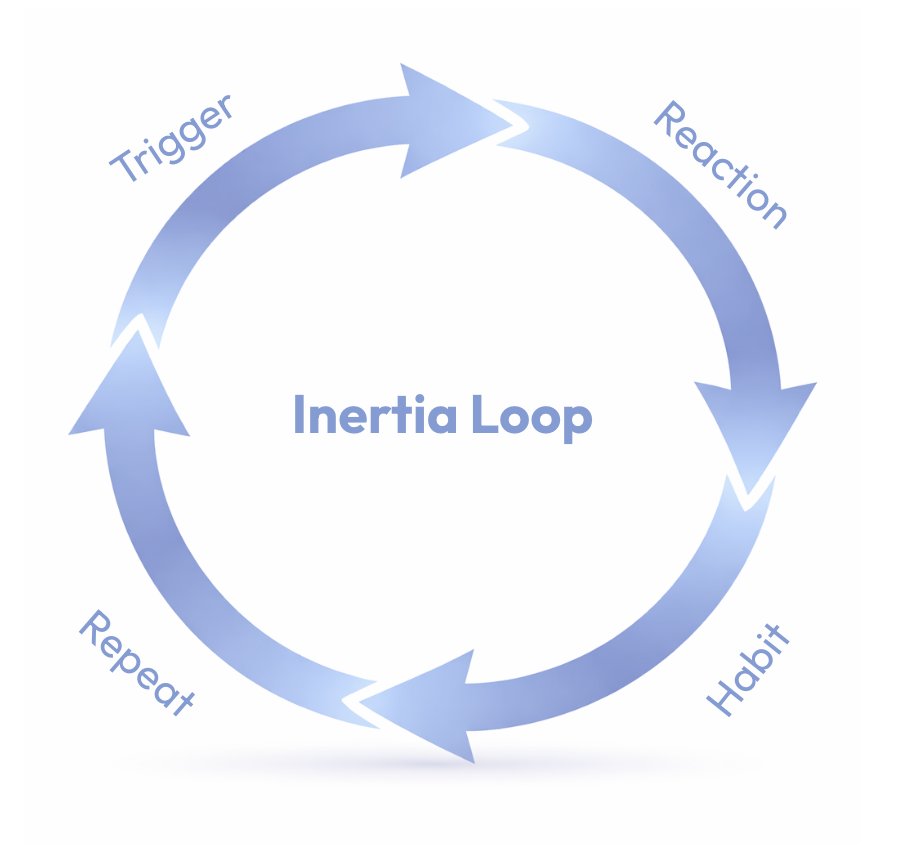
It's called a loop because it doesn't stop at the behaviour. It cycles:
Trigger - You get triggered by an event
Reaction - An almost instant emotional response
Habit -You act out a behaviour
Repeat - The next time a similar trigger appears, you do it again, often without realising you've started.
Being triggered is completely normal - it happens to everyone, at every level of an organisation. The problem isn't that you have an inertia loop; it's that without awareness of it, the loop runs you, and the cycle simply continues.
In my example, my loop looked like this:
Trigger - Someone not appreciating what I was doing (big catch here: they may have been, but I believed they weren't)
Reaction - Anger
Habit - The eye roll
Repeat
Two examples you might recognise
The Yes That Costs You
It’s 4pm on a Thursday, and you’re already behind on the strategy paper due tomorrow. Your calendar is back-to-back until 6, and your manager pings you asking for slides for Monday’s client meeting, nothing major. You feel it immediately: that tightness in your chest and the discomfort at the thought of saying no.
So you say yes. Of course you do. And by Monday, you’ve delivered the slides after staying up late and cutting corners on your own work, feeling quietly resentful the whole time. And when the next request comes, you’ll say yes again because the pattern is already set. And you feel stuck and stretched thin and quietly frustrated with yourself, without quite understanding why.
The Rage That Surprises You
Someone’s late to the meeting again, third time this month. Or you’re drowning in work, and someone drops another task on your desk like it’s nothing. And the anger hits fast, too fast, and you snap.
You say something about respect and professionalism and people not pulling their weight, and then almost immediately the guilt arrives: why did I react like that?
So you shut down and stop asking for help and start doing everything yourself because at least then no one can let you down. But the anger is still there, waiting. And it’ll be back next time.
Why this matters for leadership
Your patterns are contagious and this is the bit most leadership development misses.
When one person in a team defaults to control under pressure, others learn to wait for direction instead of thinking for themselves. When someone avoids difficult conversations, the whole team learns that accountability is optional. When a leader goes quiet under stress, the team picks up on it and mirrors it back. Your patterns become team behaviours, team behaviours shape culture, and culture determines what your business can and cannot achieve.
This is why understanding your inertia loop isn't a soft skill or a nice-to-have. You don't need hours of coaching or months of therapy to do this work — what you need is to see the loop, the trigger, the emotion beneath the emotion, the behaviour it produces, so you can start to catch it a beat earlier each time. That's where the shift actually begins.
This is where the work begins
These loops exist in all of us, and most of the time we're living inside them without realising it… reacting, recovering, reacting again. When you can name your loop, you start to have a choice. Not immediately, not perfectly, but a choice you didn't have before. And once you practice noticing your patterns and changing your responses, you gain much more choice — and, honestly, much more peace.
These changes ripple into your team, your company culture, and your business. So much becomes possible when you understand your own regulation and how you interact with the people around you.
The pattern starts and ends with you.
Ready to see your loop?
If this has landed somewhere, I'd love to help you take it further.
Pattern Power™ workshops are designed for leaders and teams who want to go from good to genuinely great - a full day of self-awareness, trust-building, and the kind of honest work that actually shifts culture. Reach out directly, or take a look at how we work - I'd love to talk.
